There was a time not too far in the distant past when getting found online meant almost exclusively one thing: showing up in search engine results. Build a great website, publish helpful content, follow SEO best practices and climb your way up the rankings.
Sound familiar? Those efforts still matter and still pay off. However, spoiler alert…search isn’t happening in just one place anymore.
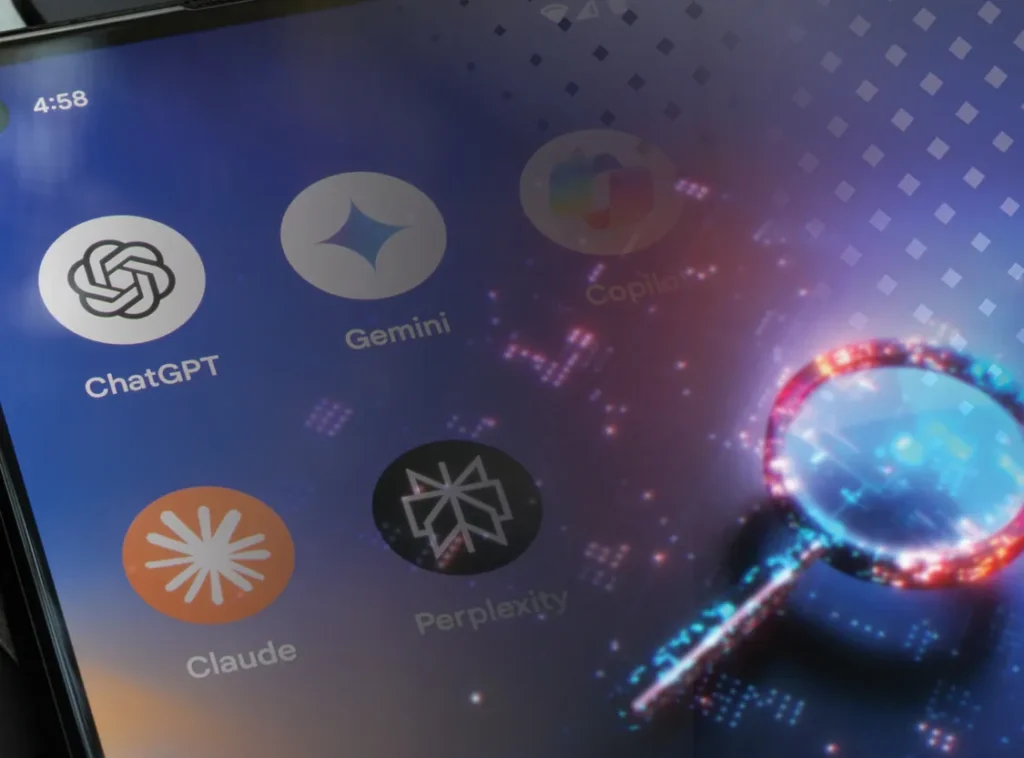
Today’s buyer might use tried-and-true Google or a similar traditional search engine but then get the answer they need from an AI Overview without clicking a link. They might not search at all, opting instead to ask ChatGPT, Gemini, Claude, etc.
Visibility, in other words, now takes place both inside and beyond search.
That’s where SEO, AEO and GEO come in. The acronyms may sound like three competing marketing strategies jockeying for key position, but they’re better understood as interconnected parts of a modern search strategy. This strategy trifecta when used correctly can help your business get found, provide answers and earn visibility wherever your audience is searching.
What Does This Shift Mean for B2B Companies?
B2B buying journeys rarely begin anymore with a buyer ready and eager to fill out a contact form. Well before that happens, they’ve already put on their research hat and done preliminary online browsing which may or may not include clicking on your perfectly optimized result. A buyer may get the answer they need directly from a search engine. Or they might ask a bot a question, receive a synthesized answer from several sources and never step a virtual footstep in your website at all.
And that’s okay. That’s not necessarily a problem. It just means that businesses not only need to rank for relevant questions, but they also need to communicate clearly enough that their content can be featured as an answer. They also need to establish sufficient authority that their content will be used as a reference by AI-driven answers.
In other words, being searchable is no longer enough to get the job done. Businesses also need to be answerable and credible enough to be selected.
SEO vs. AEO vs. GEO: What’s the Difference?
The easiest way to understand SEO, AEO and GEO is to look at what each is trying to accomplish.
| SEO | AEO | GEO | |
| Think | Ranking | Answering | Selection |
| Primary goal | Appear prominently in traditional search results | Become a direct answer to a user’s question | Be selected or cited in AI-generated responses |
| Where it happens | Google, Bing and other traditional search results | AI Overviews, featured snippets and other direct-answer experiences | ChatGPT, Gemini, Claude and other generative AI platforms |
| Typical user behavior | Clicks through to a website | May receive an answer without clicking | Receives a synthesized response from multiple sources |
| Common success measures | Rankings, organic traffic, clicks and conversions | Direct-answer and AI Overview visibility | Brand mentions, citations and share of visibility |
The distinctions between each are important, but they’re also part of a larger goal. At their core, all three strategies rely on the same basic principles: providing information that’s useful, easy to access and authoritative enough that it’s used by search engines (and AI systems) as a reference.
With that, let’s take a closer look at how each one fits into your overall search strategy.
SEO: Helping Your Business Get Found
Search engine optimization (SEO) is the most familiar of the three. It focuses on traditional search engine results and getting your content to show up prominently in those results.
That includes understanding what people are searching for, creating content that matches their intent, organizing pages so search engines can understand them (technical SEO) and becoming a trusted authority, whom people want to link to (authority and link building).
The traditional goal is pretty straightforward: someone searches, sees your result and clicks through to your website.
A buyer searches Google for manufacturing companies, for example, and considers clicking on your local competitor. SEO increases the chances you’ll click your business instead.
And despite all the recent chatter to the contrary, SEO isn’t dead. It’s still an essential foundation for online visibility. What’s changing is the search environment around it.
AEO: Becoming the Answer
Answer engine optimization (AEO) takes the next step.
AEO extends SEO into direct answers. That can mean concise explanations, descriptive headings, question-and-answer formats, lists, tables and other structures that clearly communicate information.
The user may never reach your website. But if your information helps provide the answer, your brand can still gain visibility.
Put simply, SEO helps someone find your content. AEO optimizes for answers.
GEO: Helping Your Business Earn Visibility
Generative engine optimization (GEO) extends the idea into generative AI.
Platforms such as ChatGPT, Gemini, Claude, etc. can synthesize responses using information from multiple sources rather than simply presenting a ranked list of webpages. GEO focuses on increasing the likelihood that a company’s information, expertise or brand becomes part of those responses.
That puts greater emphasis on several factors such as authority, accuracy, useful original information, content depth, consistency and broader brand presence.
The question then changes from “How do we rank?” to “How do we become a source worth using?”
And that’s hugely significant, especially for B2B companies whose expertise is often one of their strongest competitive advantages.
How SEO, AEO and GEO Work Together
Here’s where things can get unnecessarily complicated, but it doesn’t have to be.
SEO, AEO and GEO don’t require three completely separate content strategies. It’s quite the opposite. In fact, treating them that way can create more work without necessarily creating better results.
Think of them as working in layers and building off each other. As LLM Pulse puts it: SEO provides the foundation, AEO builds the answer layer and GEO carries that visibility into generative systems.
SEO creates the foundation. Your content needs to be useful, accessible, technically sound and aligned to what your audience is searching for.
AEO adds clarity. Important questions should be answered directly. AEO helps organize that content so your answers are clear, direct and easy to understand. Is the question you want to rank for answered clearly on the page? Is the page organized in a way that’s easy for search engines (and people) to understand?
GEO builds on authority. Your company needs content and a broader digital presence that gives AI systems reasons to recognize it as a credible source of information.
In essence, SEO, AEO, and GEO all work together.
Search used to be about rankings. Today, it’s about selection. As AI search has grown, some experts have described the shift as moving from rankings to selection: businesses still need to be found, but they increasingly need to be selected as a source, too.
Which leads to the next question: which strategy has the most impact? Well, it really depends on your goals.
| Strategy | Most Impactful For | What Success Looks Like |
| SEO | Search visibility and driving qualified website traffic | Rankings, impressions, clicks, organic traffic and conversions |
| AEO | Owning answers to relevant questions | Direct-answer visibility and inclusion in AI-powered search experiences |
| GEO | Building visibility within generative AI research | Brand mentions, source citations and presence across relevant AI responses |
Common Misconceptions and Challenges
Because SEO, AEO and GEO overlap, it’s easy to draw some overly simple conclusions about what businesses should do next.
“SEO is dead
Far from it. While the search landscape is constantly changing, most of the fundamentals still apply. If your website isn’t accessible to search engines, your content isn’t organized or valuable, and you don’t have a basic understanding of SEO, prospects still aren’t going to magically find you.
“GEO is just SEO for AI”
There’s certainly some common middle ground, but the goals aren’t identical. Traditional SEO primarily focuses on ranking pages in search results. GEO also considers whether your brand and information are recognized as credible sources within synthesized responses.
“We need three separate strategies”
No, not really. That can create unnecessary silos; and who really wants that? The better approach is to build a strong, shared foundation and then consider what each search solution requires. Because at their core, all three are about using content to communicate with your audience where and how they’re searching.
“More content means more visibility”
Let’s be honest, search engines don’t care about how many blog posts you crank out and publish. But they do reward websites that offer useful and relevant content and help visitors find the answers they need.
People are still Googling left and right, but they’re also asking questions to ChatGPT. They run into direct answers and interact with information gathered from across the web every time they speak to a generative AI system.
Building a Search Strategy for What Comes Next
The good news? You don’t need to toss out everything you know about content marketing and start from scratch. So, that’s a relief.
Instead, you just need to expand how you think about visibility.
For B2B companies, that starts with knowing your audience. What are they trying to understand? What problems are they trying to solve? What information do they need before they’re comfortable moving forward?
Then create content that genuinely helps them get there.
That might include detailed product and service pages, educational blogs, technical resources, case studies, FAQs, comparison content or thought leadership built around your company’s actual expertise.
From there, make the information easy to read and find. Use descriptive headings. Answer important questions directly. Keep facts and examples current. Provide enough context to demonstrate expertise without burying the answer.
And don’t limit yourself to what’s happening on your website. Think above and beyond. A company’s broader digital presence can help reinforce its authority and credibility across the web – an increasingly important consideration as generative systems evaluate information from multiple sources.
Think of it like this:
Write for people. Structure for search. Build authority for AI.
Those aren’t three separate jobs. Done well, they’re parts of the same one.
SEO + AEO + GEO: Better Together
Search isn’t disappearing. It’s evolving.
Sure, people are still Googling like normal. They’re also seeing direct answers, encountering AI-generated summaries and chatting with search in more natural ways. So, what is the opportunity for B2B brands? Making sure their useful, credible content has the chance to surface for whatever type of search experience their customers are using.
So the choice isn’t businesses deciding whether they should invest in SEO, AEO or GEO. It comes down to whether they are building the kind of digital presence that can be found, understood and trusted wherever their customers are looking for answers.
At Cain & Company, we help B2B companies build search strategies around that bigger picture from SEO and content strategy to evolving opportunities in answer and generative search. Because the way people search may be changing, but the goal hasn’t: connecting the right audience with the right information at the right time.
Ready to strengthen your search strategy? Let’s talk.
FAQs About SEO, AEO and GEO
Is SEO being replaced by AEO or GEO?
No. AEO and GEO expand the ways businesses are seen, but they still rely heavily on many of the same fundamentals as SEO: accessible websites, strong content, clear information and authority. SEO remains the foundation rather than an outdated strategy.
What’s the difference between AEO and GEO?
AEO is about getting your information organized in a way that can be displayed as a direct answer in search. GEO focuses on earning visibility within answers generated by AI systems, which may pull from a variety of sources. The two overlap significantly, but they emphasize different search environments.
Does existing SEO content need to be rewritten for AI search?
Not necessarily. Strong existing content may simply need to be evaluated differently. Clearer answers, stronger organization, updated information and additional context can make a useful page easier to understand for both people and search systems.
Where should a B2B company start?
Start with the foundation. Make sure your website and content are useful, accessible and answering the questions your audience is asking. Then look at where you’re currently visible and where you aren’t, across traditional search, direct-answer experiences and generative AI platforms. From there, SEO, AEO and GEO should become tools in your search strategy, not competing solutions to separate problems.